Afghanistan has two sites inscribed on the UNESCO World Heritage List — both cultural — and four more on the Tentative List awaiting nomination. Every single one of these sites features in our tour itineraries. This is not a list we copied from a textbook. We drive past the Minaret of Jam, walk through the Bamiyan niches, and take our groups into the turquoise lakes of Band-e-Amir — and what follows is what we have learned from doing exactly that, year after year.

Cultural Landscape and Archaeological Remains of the Bamiyan Valley
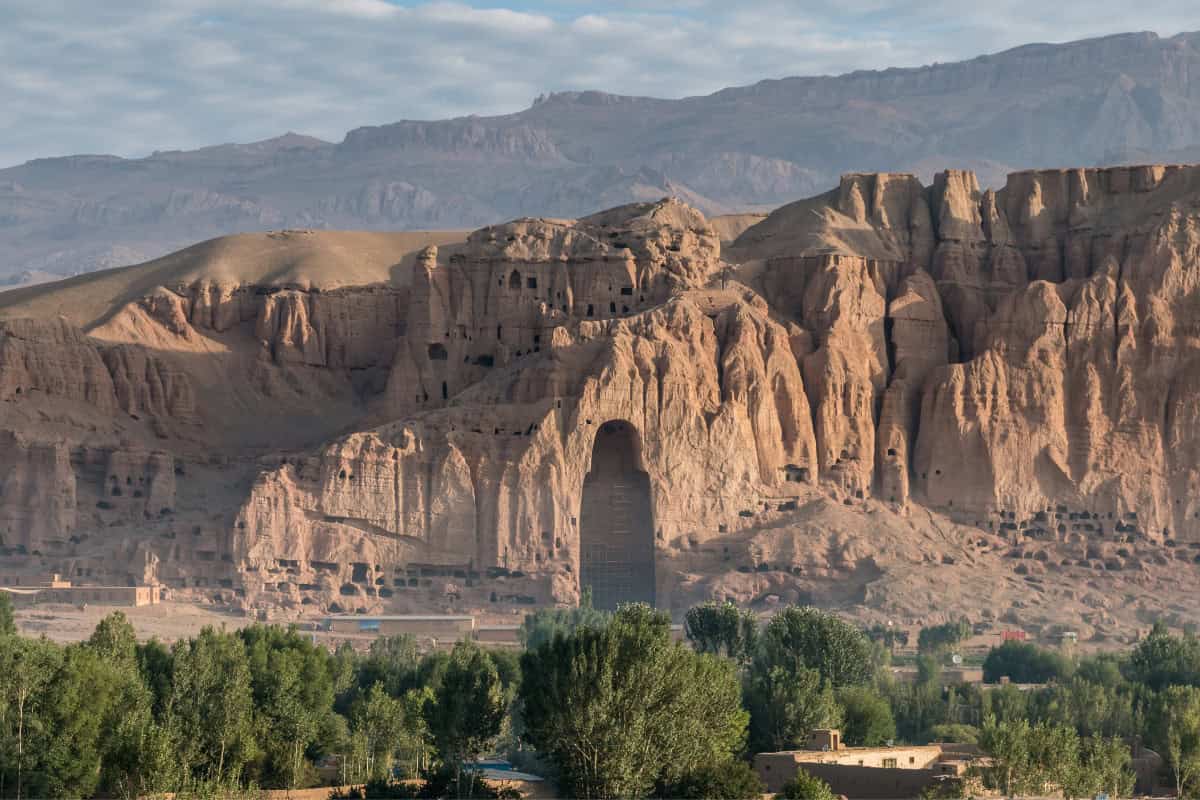
The Bamiyan Valley sits in the central highlands of Afghanistan at roughly 2,500 metres elevation, ringed by the red-brown cliffs of the Hindu Kush. For more than 1,500 years, two colossal Buddha statues — one standing 55 metres, the other 38 metres — were carved into the sandstone face of these cliffs, forming the centrepiece of a vast Buddhist monastic complex along the ancient Silk Road.
The statues were destroyed by the Taliban in March 2001. The empty niches remain — enormous, haunting, and impossible to forget when you stand at their base and look up. The surrounding cliff face still holds hundreds of caves containing fragments of ancient murals, meditation chambers, and the remains of monasteries that once hosted pilgrims from across Central and East Asia.
Beyond the Buddha niches, the Bamiyan Valley includes the fortified ruins of Shahr-e Zohak (the “Red City”) and Shahr-e Gholghola (the “City of Screams”), both destroyed by Genghis Khan’s forces in 1221. These fortress ruins are visible from the valley floor and are part of every itinerary we run through Bamiyan.
The road from Kabul to Bamiyan covers approximately 174 kilometres and takes around two and a half to three hours depending on road conditions. We use this drive to brief our groups on the history of the Hazarajat region and what to expect at each site.

Minaret and Archaeological Remains of Jam
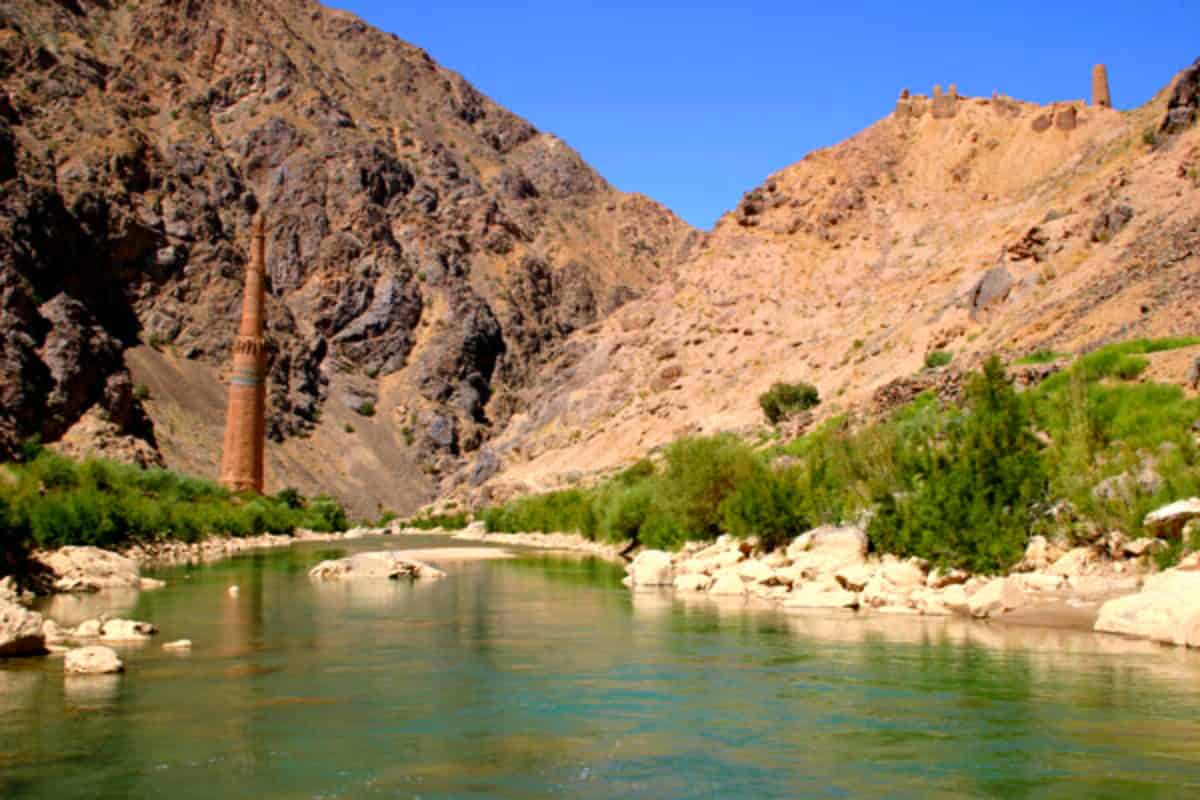
The Minaret of Jam was Afghanistan’s first site inscribed on the UNESCO World Heritage List, added in 2002. It stands 65 metres tall in a narrow river valley at the confluence of the Jam and Hari Rivers in the remote Shahrak District of Ghor Province — deep in the mountainous interior of western Afghanistan, far from any paved road.
Built around 1190 during the Ghurid dynasty, the tower is constructed entirely of baked brick and decorated with alternating bands of Kufic and Naskhi calligraphy, geometric patterns, and Quranic verses. The eastern face bears an inscription in ornamental Kufic script, and the architect — Ahmad ibn Ibrahim al-Naysaburi — signed his name in cursive on the structure. Inside, a double spiral staircase of 159 steps winds around a central pillar up to two wooden balconies.
The archaeological landscape around the minaret includes the ruins of a palace, fortifications, a pottery kiln, and a Jewish cemetery. Researchers believe this may be the remains of Firuzkoh — the legendary “Turquoise Mountain” that served as the Ghurid summer capital. The Ghurids controlled much of what is now Afghanistan, eastern Iran, Central Asia, and northern India during the 12th and 13th centuries, and this minaret may commemorate their 1186 victory over the Ghaznavids at Lahore.
The structure has been on UNESCO’s List of World Heritage in Danger since its inscription. It has suffered from flooding, earthquake damage (including a 2022 earthquake that dislodged bricks), and a near-total absence of conservation work since the 1970s. Stabilisation efforts have started and stopped repeatedly due to political instability.
Why We Built Our Own Ground Operation
We had been running Afghanistan tours through other local operators for years, and we were never satisfied with the quality or the way visitors were treated. Then we met Hussain Naveed — at the time an English teacher and education activist. We convinced him to partner with us and build a tour operation from the ground up, with one core principle: the visitor comes first. Always.
Hussain is Hazara. He grew up as an orphan, graduated university, and then built an education centre in the Hazarajat region that has served more than 300 students — most of them girls — under Taliban rule. The guides who work with us in Afghanistan — Hussain, Hassan, Khalil — are not hired hands. They are partners who know every road, every checkpoint, and every village elder in the regions where we operate.
4 Sites Awaiting Nomination
In addition to the two inscribed World Heritage Sites, Afghanistan maintains four properties on its UNESCO Tentative List — sites being considered for future nomination. We visit every one of them on our regular tour itineraries.
Herat — The Timurid Capital
The city of Herat in western Afghanistan was one of the great centres of the Timurid renaissance in the 15th century. The Citadel of Herat (Qala-e Ikhtiyaruddin) was first built by Alexander the Great around 330 BC and has been rebuilt by every empire since — Greeks, Mongols, Timurids, Safavids, British. The Friday Mosque of Herat, with its vast courtyard and centuries of continuous tile restoration, is one of Afghanistan’s most impressive standing monuments. The city’s tentative listing reflects its importance as a crossroads of Persian, Central Asian, and Islamic architecture spanning more than two millennia.
Included on our 10-day group tour & 7-day private tourBalkh — The Mother of Cities
Known in antiquity as Bactria, Balkh is one of the oldest cities in the world. Located near modern Mazar-i-Sharif in northern Afghanistan, it was a centre of Zoroastrianism, Buddhism, and Islam at different points in its history. The No Gombad Mosque (9th century) is one of the oldest Islamic monuments in Afghanistan — its carved columns mark the precise architectural moment where Buddhist design gave way to Islamic form. The city’s ruins, including its massive earthen walls, stretch across the desert plain.
Included on all tours that visit Mazar-i-SharifBand-e-Amir — Afghanistan’s First National Park
Band-e-Amir is a chain of six turquoise lakes at approximately 3,000 metres elevation in the Hazarajat, about 75 kilometres northwest of Bamiyan. The lakes were formed by mineral-rich water seeping through faults in the limestone, depositing travertine dams that now contain the water — one of only a handful of such systems anywhere on Earth. Band-e-Haibat, the largest and deepest lake, has an estimated average depth of 150 metres. The park was officially designated in 2009 after decades of delay due to war, and has been submitted to UNESCO for World Heritage consideration. The contrast between the arid, red-brown mountain terrain and the vivid blue water is unlike anything else in Central Asia.
Full-day 4WD expedition on all tours that include BamiyanBagh-e Babur — Gardens of the First Mughal Emperor
Bagh-e Babur (the Gardens of Babur) is an 11.5-hectare historic garden on the slopes of Kuh-e Sher Darwaza hill in Kabul. Founded around 1504 by Zahir ad-Din Muhammad Babur after his conquest of Kabul, it is one of the earliest surviving Mughal gardens. The site is arranged across 15 terraces along a central axis descending westward toward the Kabul River, in the tradition of Timurid char bagh design — a symbolic representation of the eight gates of paradise. Babur’s tomb lies at the top, with a white marble mosque commissioned by Shah Jahan on the thirteenth terrace below. Badly damaged during the civil war of the 1990s, the garden was restored by the Aga Khan Trust for Culture starting in 2002 and now welcomes up to one million visitors per year. It has been on UNESCO’s Tentative List since 2009.
Included in all tours — Kabul city dayVisiting Afghanistan’s Heritage Sites
See These Sites With the Operator Who Knows Them
Every heritage site on this page is part of a real itinerary we run — not a wish list. Browse our Afghanistan tours or contact us to build something custom.