10,000+ Travelers Served with574+ 5-Star Reviews
Questions? Chat with us on WhatsApp+971-523-549-709

Iran Visa on Arrival

Step-by-step process, fee tables, eVisa guide, nationality rules, and current status — written by someone who has been through Tehran airport more times than he can count. Page last updated April 2026.

Iran Visa on Arrival

Current Status — April 2026

Iran visa-on-arrival is currently suspended

Due to the 2026 US–Iran conflict, Iran’s international airspace has been closed and all inbound tourism is halted. Imam Khomeini International Airport (IKA) has suspended outbound civilian flights, and the visa-on-arrival service at the airport is not operational. This page remains live as a reference for when conditions change — and our local partners in Iran believe they will, if the ceasefire holds.

RJ Travel stopped operating Iran tours in January 2024 to comply with UAE-based sanctions obligations. This guide is maintained as a public resource for independent travelers.

Iran Visa on Arrival Tehran Airport IKA
JL
João Leitão
Founder & CEO, RJ Travel LLC — UAE · ONMT-licensed operator, Morocco

I first entered Iran in 2004, arriving overland from Uzbekistan on a solo backpacking trip through Central Asia. I have been back more times than I can precisely count — for kung fu practice, for leading group tours, for a two-month overland crossing with my family in a campervan. In September 2023, I spent an entire month in Iran managing multiple consecutive group tours, approximately 50 travelers total across different departures. I have personally processed visa-on-arrivals at Imam Khomeini International Airport on several occasions, both for myself and while assisting my tour groups. As a Iran tour operator, we have taken hundreds of travelers through Persia across multiple years of group and private departures.

2004 First Iran visit
~6 months Total time in Iran
50+ Travelers led
160+ Travelers served
145+ Countries visited

My first time through Tehran airport was memorable for the wrong reason. My Portuguese passport, like many issued in that era, had a full-page illustration on its inside cover — a classic tile-work depiction of a bare-breasted sea nymph, part of Portugal’s Age of Discovery iconography. The immigration officer flipped to it, froze, held it up and said: “What is this? I cannot stamp the Islamic Republic of Iran onto this… this disco passport.” He examined it for what felt like five minutes, muttering. Then he stamped it, smiled, and said “Welcome to Iran.” I was in the country for six weeks after that. It is, to this day, one of my favourite border crossings.

— João Leitão, Imam Khomeini International Airport, September 2004

I went back in 2012 with my wife. I went back in 2018 with my wife and our son, for a two-month overland crossing in a Mercedes Sprinter 4×4 campervan. I went back in 2023 to lead tours. Iran is, whatever the politics, one of the countries I know best on earth: extraordinary food, some of the most significant archaeological sites anywhere on the Silk Road, and a population whose warmth toward foreign visitors has consistently exceeded anything I encountered in the surrounding region. This guide is written from that accumulated experience, not from a Wikipedia page.

What is the Iran visa on arrival?

The Iran visa on arrival (VOA) is a tourist visa issued at the point of entry — most commonly at Imam Khomeini International Airport (IKA) in Tehran, but also at several other international airports and the Shahid Rajaee Port in Hormozgan Province. It does not require a prior appointment at an Iranian embassy. You show up, process the paperwork at the airport, pay the fee, and enter the country.

This is different from the Iran eVisa, which is applied for online before travel and is now the preferred route for most nationalities. The VOA can technically still be issued to eligible nationals at the airport without a pre-obtained eVisa — but since 2022, some airlines have started requiring a valid visa code before allowing boarding, making advance preparation the only reliable option. Turning up at the departure gate for Tehran with no prior visa code has resulted in passengers being denied boarding, regardless of their technical VOA eligibility.

!
Airline pre-boarding requirement (since 2022)

Several airlines — primarily European carriers — have begun requiring passengers to show a valid Iranian visa code before boarding. The VOA technically still exists at the airport, but showing up without any prior documentation is a risk. Get your eVisa authorization code before flying. See section 05 below.

Iran introduced the VOA system progressively. For a brief period in the mid-2010s, EU nationals could arrive at any international airport and obtain a visa with no prior online application at all — pure walk-up. I used this system myself on several entries. That era ended: the eVisa pre-authorization system is now the standard baseline for most nationalities, and the pure walk-up VOA has been phased out for practical purposes even if it remains technically available.

What you need for an Iran visa on arrival

  • 1

    Passport valid for at least six months

    Beyond your intended departure date from Iran. If you plan to extend and stay up to 90 days, your passport must remain valid for at least six months after your last permitted day in the country.

  • 2

    eVisa authorization code (strongly recommended)

    Applied for in advance through the Iranian Ministry of Foreign Affairs online portal, or through a licensed Iranian travel agency. Approval typically takes 3–10 working days. Without this, some airlines will not let you board. See section 05.

  • 3

    Travel insurance

    Required on arrival. You can purchase Iranian travel insurance at the airport VOA desk if you do not have it. RJ Travel used to arrange this as part of tour packages; independent travelers should budget 15–20 USD for airport-purchased insurance.

  • 4

    Hotel reservation for first night

    A printout or confirmation email showing at least your first night’s accommodation. This is asked for at the VOA desk and occasionally at passport control.

  • 5

    Visa fee in cash (euros or USD)

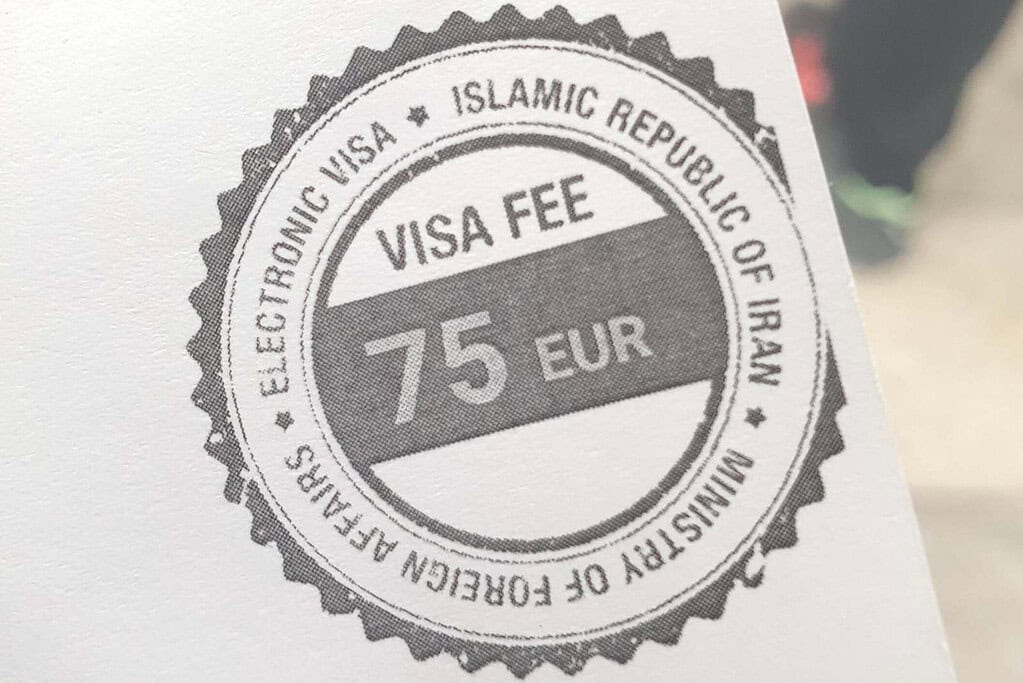
    Foreign bank cards do not work in Iran due to international sanctions. You must pay the VOA fee entirely in cash. Most commonly 75 euros plus a 3 USD bank commission. Exact fee depends on your nationality — see the full table in section 06. They will give change.

!
US, UK, and Canadian passport holders — different rules

Standard VOA does not apply to American, British, or Canadian passport holders. These nationalities must obtain their visa in advance through a licensed Iranian travel agency, provide a detailed resume file (education, employment, social media), and travel with a certified guide at all times. The visa process for these nationalities takes approximately 8 weeks. See section 10 for full details.

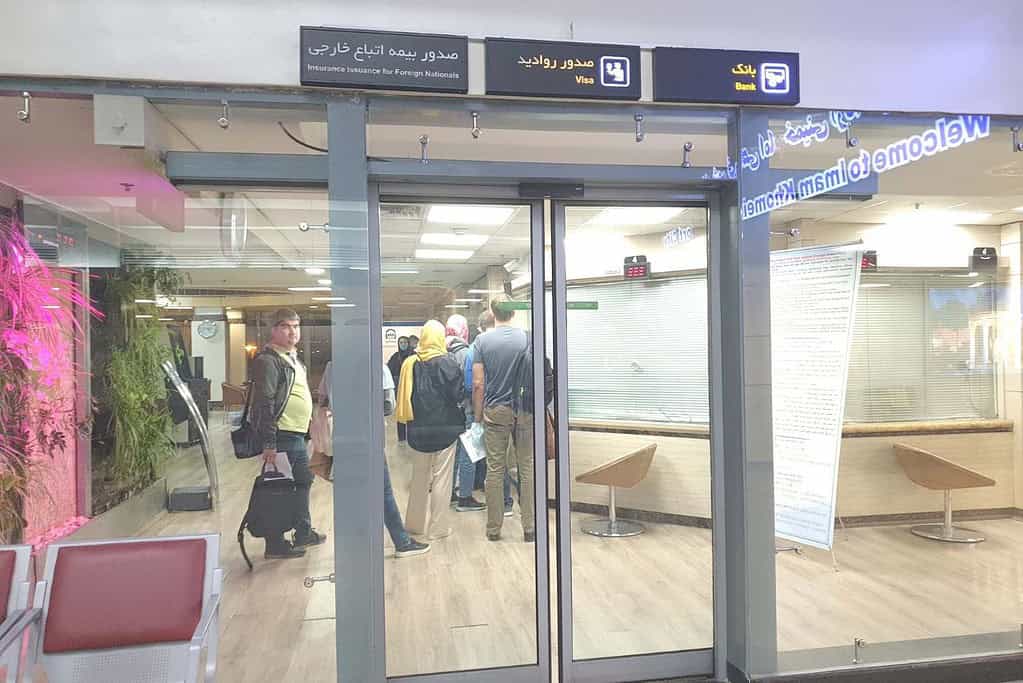
Tehran Airport — Iran tourist visa on arrival processing area

The airport process at Tehran’s International Airport

The following is based on direct personal experience at IKA on multiple occasions, most recently in 2023 while managing tour groups through the airport. This is what you actually encounter, not what the official documentation describes.

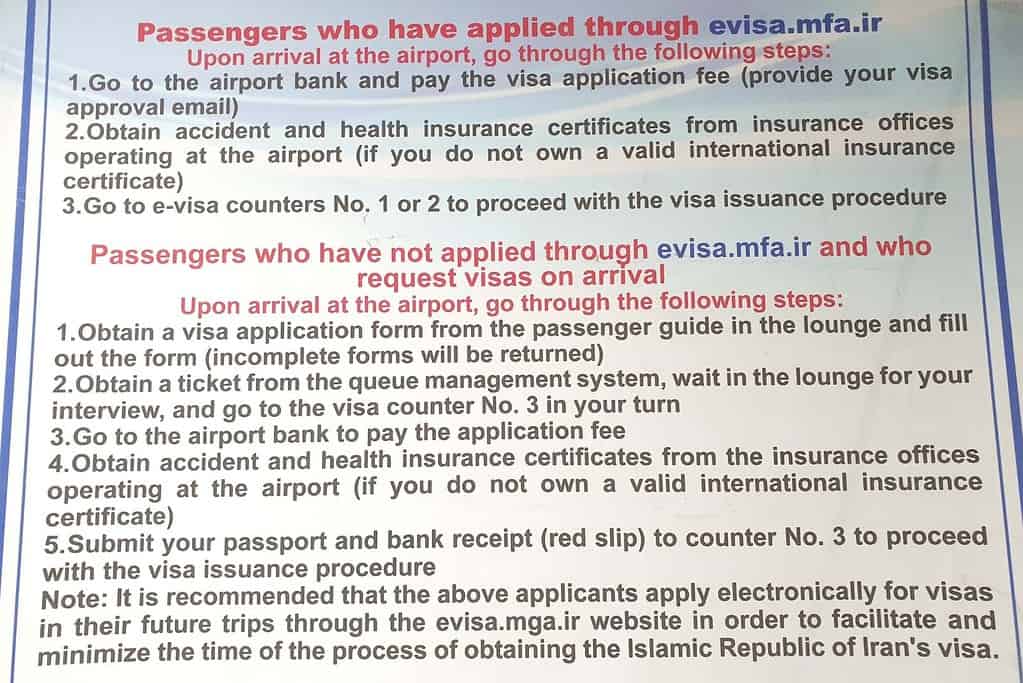
  • 1

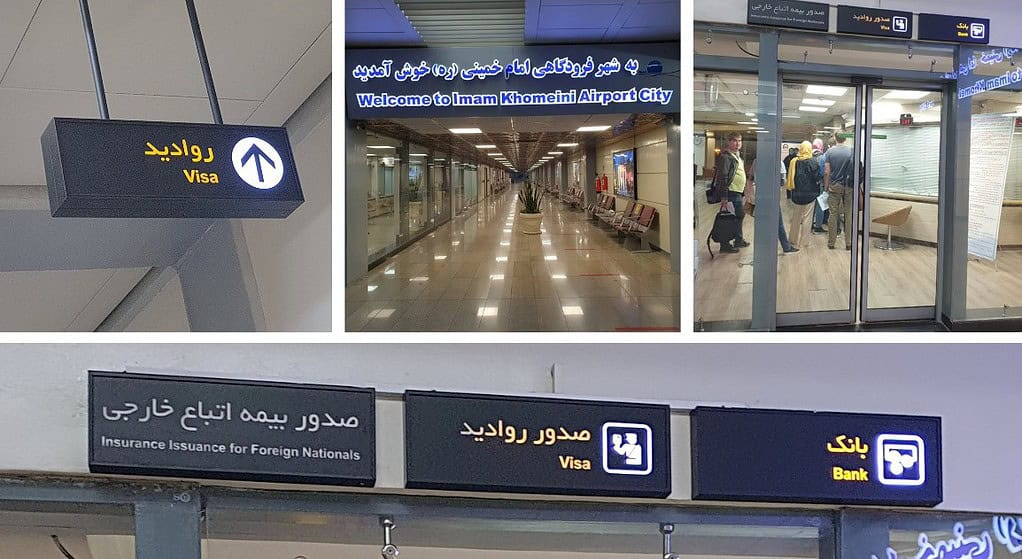
    After landing — follow the VISA signs, not the passport stamp queue

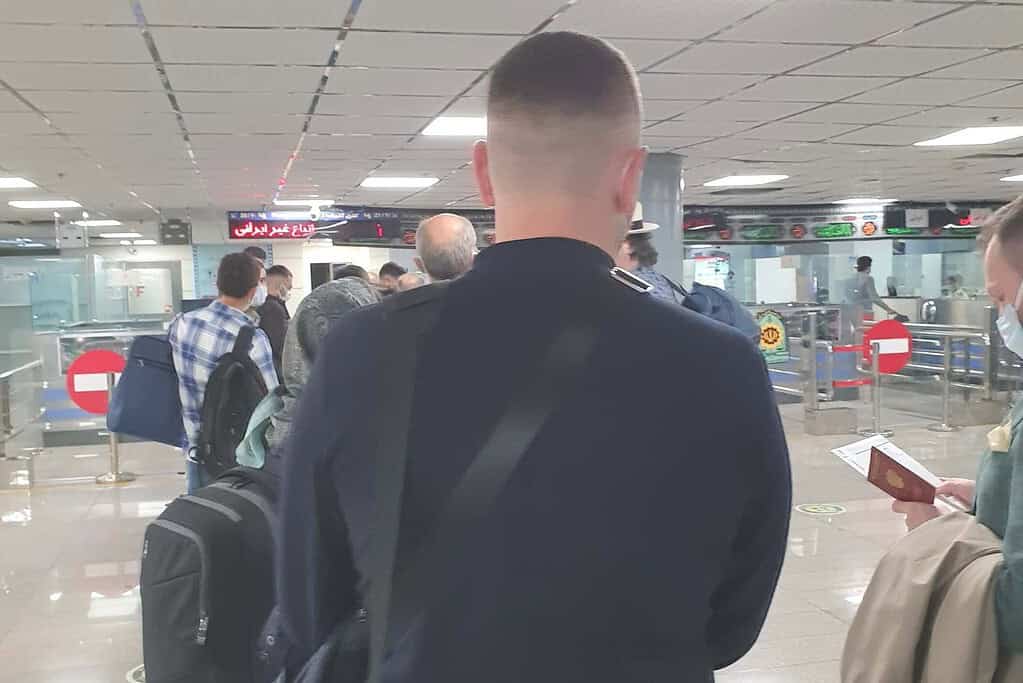
    When you exit the plane and follow arrival signs, you will come to a fork. The large main queue leads to passport control for visa holders. Do not join this queue if you are getting a VOA. Follow the smaller signs that say VISA. There is a section marked with the text “Welcome to Imam Khomeini Airport City” — the VOA area is through an automatic door in this zone. It is not always prominently signed in English; if in doubt, ask any airport staff member for the “visa on arrival” desk.

  • 2

    Present your eVisa code and passport at the VOA desk

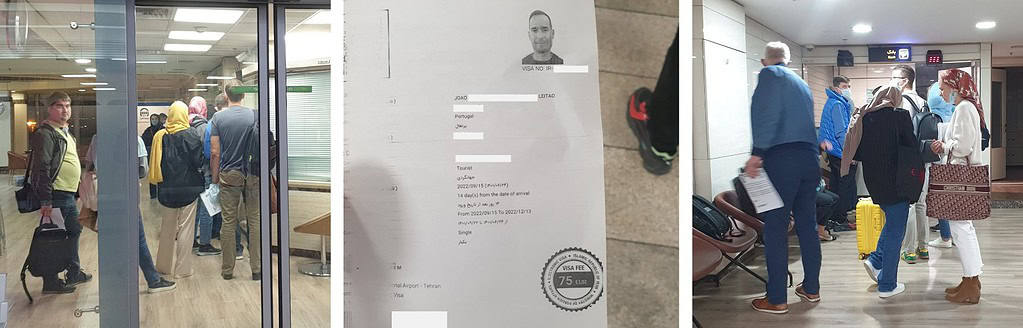
    Hand over your passport, your printed eVisa authorization code (or the digital version on your phone), your hotel reservation, and your travel insurance. The officer will review your documents and issue a VOA voucher paper — this is your actual visa document.

  • 3

    Pay the visa fee at the bank counter on the left

    Take the VOA voucher to the bank counter inside the visa area (usually to the left of the main desk). Pay in cash — euros or US dollars. The fee is typically 75 euros for most European passport holders, plus a 3 USD bank processing fee. If you hand over 100 euros, you will receive change. Keep your payment receipt — you will need it.

  • 4

    Return to the VOA desk with your receipt and voucher

    Go back to the window where you started and hand over your passport, the VOA voucher, and the bank payment receipt together. The officer will attach the visa page to your passport. Ask them to confirm everything is in order before leaving the desk.

  • 5

    Join the passport control queue — you’re done

    Leave the VOA area and join the regular passport control queue. The visa is now in your passport. Processing times at the VOA desk typically run 20–45 minutes depending on how many others are doing the same. At peak arrival times it can take longer. Factor this into any connections.

i
Note on biometric and entry data

Iran takes fingerprints and a photograph at passport control as part of the entry process, separate from the VOA desk. This is standard for all foreign nationals entering Iran. It happens at the passport stamp window, not at the VOA desk.

Iran eVisa — apply before you fly

The Iran eVisa (electronic visa) is the recommended route for all eligible nationalities. It is applied for through the Iranian Ministry of Foreign Affairs portal at evisa.mfa.ir. The eVisa itself is not affixed to your passport — it generates an authorization code that you present at the Iranian airport, where the physical visa is then issued and attached to your passport. Think of the eVisa as a pre-authorization, not the visa itself.

How to apply for the Iran eVisa

  • 1

    Go to evisa.mfa.ir/en

    This is the official Iranian Ministry of Foreign Affairs portal. Alternatively, you can apply through a licensed Iranian travel agency, which is the recommended route for US, UK, and Canadian nationals and is also significantly more reliable for most travelers — agencies can chase up delays and flag issues before they become problems.

  • 2

    Complete the application form

    Fill in your personal details, passport information, intended arrival date, and a rough travel plan (where you will stay, what you intend to visit). Attach a digital passport-sized photo and a scan of your passport bio page. Most European nationalities only need these basics; US, UK, and Canadian citizens must also submit a detailed resume file.

  • 3

    Wait for approval — typically 3–10 working days

    Processing times vary. Allow at least two weeks before your travel date. Applications can be delayed or, in rare cases, refused without explanation — there is no formal appeals process. If you are on a tight timeline, apply through an agency rather than directly through the portal.

  • 4

    Print your authorization code and bring it to the airport

    Once approved, you receive an authorization code by email. Print this document. Some airlines require you to show it at check-in. Present it at the VOA desk at the airport, where it is exchanged for the physical visa sticker (or paper visa) placed in your passport.

Kish Island and Qeshm Island: visa-free for 14 days

All nationalities eligible for a VOA can enter Kish Island or Qeshm Island (both Free Trade Zones) for up to 14 days without any visa at all — provided they remain within the island. Many travelers based in Dubai or the Gulf use this for short weekend trips. No eVisa required, no fee. This option is still subject to the current airspace and travel restrictions in place during the 2026 conflict.

Iran visa on arrival fees

Iran visa on arrival fees by nationality

The standard Iran VOA fee for most European nationalities is 75 euros plus a 3 USD bank processing commission. Fees vary by passport. The table below reflects the fee structure that was in place during the last operational period (2023–early 2024). Fees are subject to change; treat this as a baseline and verify at the time of travel.

i
Cash only — foreign cards do not work in Iran

Due to international sanctions, no foreign bank cards or credit cards function in Iran. You must pay the VOA fee entirely in cash. US dollars and euros are both accepted at the airport bank counter. They will give change. Do not rely on finding a working ATM after entry.

VOA FeeNationalities
€10Armenia, Bahrain
€30Tajikistan, Morocco, Saudi Arabia
€40Nepal, Yemen
€45Indonesia, Kyrgyzstan, Mexico, Venezuela
€50South Korea, Kazakhstan, Croatia, Paraguay
€55Philippines, Nigeria, Panama
€60Japan, Turkmenistan, Cameroon, Sri Lanka, Kuwait
€70Russia, Uzbekistan, Argentina, Mongolia
€75Germany, Austria, Spain, Italy, Ireland, Iceland, Slovenia, Estonia, Belgium, Bulgaria, Portugal, Czech Republic, Denmark, Romania, Sweden, Switzerland, France, Poland, Hungary, Norway, Netherlands, Greece, Thailand, Singapore, Oman, Qatar, Cuba, Malta
€80Ukraine, South Africa, Brazil
€85Serbia
€100UAE, Uganda, Vietnam, Taiwan
€120Chile
€145Australia
€150New Zealand

All fees above plus €3 bank commission. Figures reflect 2023 operational period. Verify at time of travel. US, UK, and Canadian passport holders are not eligible for the standard VOA — see section 10.

Iran does not stamp passports anymore

Since November 2018, Iran stopped stamping foreign passports on entry or exit — for most nationalities. The Iranian government implemented this change specifically to protect travelers from consequences related to US sanctions, which penalised individuals who had visited Iran after 2011. Instead of a passport stamp, you receive a separate paper document at entry (a loose-leaf stamp or a separate visa paper). This paper is what proves your legal entry. Keep it; you may be asked for it at exit.

When I was leading tours in 2023, every single traveler in my groups passed through Iranian immigration without a stamp in their passport. They received a loose paper entry document. Some were nervous about this — “how do I prove I was here?” The answer is: you don’t need to prove it through your passport. Iran has deliberately made itself invisible in your travel document. What you do need to preserve is that paper, because Iranian border staff at exit do sometimes check it. I always told my groups: treat that paper like it is your passport.

— João Leitão, September 2023
i
Exception: US, UK, and Canadian nationals

American, British, and Canadian passport holders are an exception — their passports are stamped, including with a full sticker visa. For all other nationalities, the no-stamp policy applies. If you are getting a VOA extension during your trip, note that the extension process does leave a stamp in your passport even if the initial entry did not.

Who can get an Iran visa on arrival?

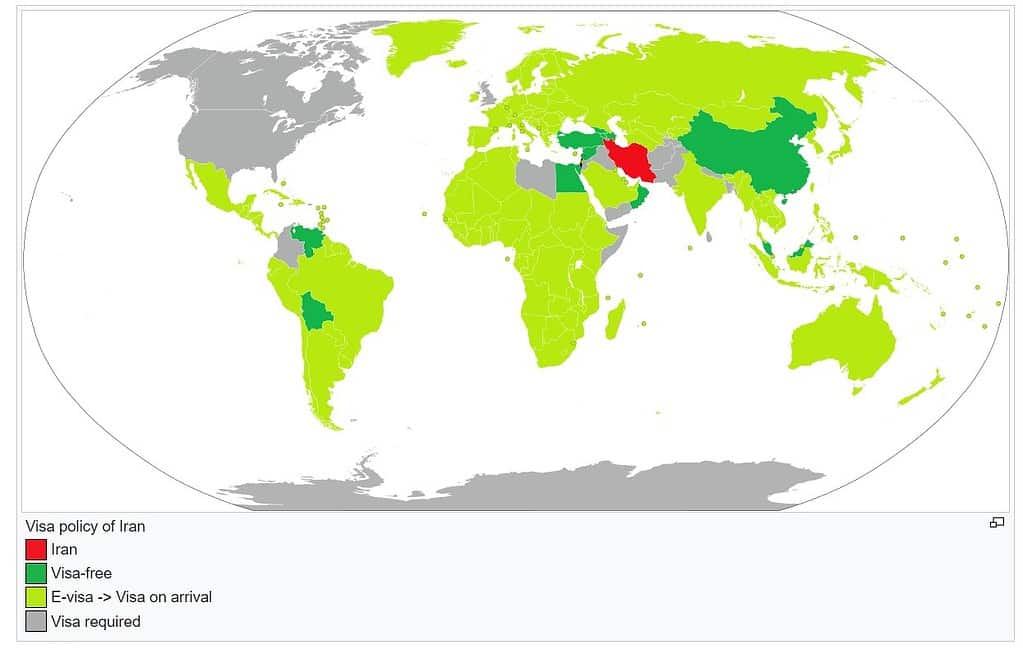
Iran’s visa policy divides nationalities into four categories: visa-free, visa on arrival, visa required in advance, and restricted (US/UK/Canada/Colombia). The following are the main country groups for standard tourist travel.

Visa-free entry No visa needed
Lebanon, Syria, Turkey, China, Georgia, Malaysia, Bolivia, Ecuador, and others — varies by duration. Check the current Iranian MFA list as this category changes.
Visa on arrival VOA eligible
Albania, Australia, Austria, Bahrain, Belarus, Belgium, Bosnia, Brazil, Bulgaria, China, Croatia, Cuba, Denmark, Finland, France, Germany, Greece, Hungary, India, Indonesia, Ireland, Italy, Japan, Kazakhstan, Kuwait, Kyrgyzstan, Luxembourg, Mexico, Mongolia, New Zealand, Norway, Oman, Palestine, Peru, Philippines, Poland, Portugal, Qatar, Romania, Russia, Singapore, Slovakia, Slovenia, South Korea, Spain, Sweden, Switzerland, Syria, Tajikistan, Thailand, Turkmenistan, Ukraine, UAE, Uzbekistan, Vietnam — and others. This list is subject to change; verify with the Iranian MFA before travel.
Visa required in advance Embassy/consulate
Afghanistan, Bangladesh, Colombia, Iraq, Jordan, Nepal, Pakistan, Somalia, Sri Lanka — must obtain a visa from an Iranian embassy or consulate before travel. VOA not available.
Restricted Special rules
United States, United Kingdom, Canada — full guided tour required, detailed resume file required, 8-week advance processing. No walk-up VOA. See section 10.
!
Israeli passport holders and Israeli stamps

Citizens of Israel cannot enter Iran. Additionally, travelers with an Israeli entry/exit stamp in their passport may face scrutiny or refusal. The Iranian MFA’s official position is that a visa can still be granted if the last visit to Israel was more than six months prior, but this is not consistently applied in practice. If you have Israeli stamps in an active passport and are concerned, renew your passport before attempting to enter Iran.

Extending your Iran tourist visa

The Iran VOA and eVisa are initially valid for up to 30 days. Extensions are possible and commonly used. The extension process is done in-country at a local police station or relevant immigration office — not at the airport.

You can extend twice, each time for an additional 30 days, for a total stay of up to 90 days. The process varies slightly depending on which city you are in. In Tehran, the main immigration office handles extensions. In other cities, the local police station is usually the correct place. Take your passport, your original visa document, a passport photo, and cash for the extension fee. Allow half a day.

!
Extension process leaves a passport stamp

Unlike the original entry (which leaves no mark in your passport for most nationalities), the visa extension process does result in a full-page stamp being placed in your passport. If you are concerned about the Iranian stamp for onward travel, factor this in before applying for an extension.

US, UK, and Canadian citizens — special visa process

American, British, and Canadian passport holders cannot use the standard VOA process. Due to the closure of Iranian foreign missions in the US and the UK’s diplomatic status, the visa process for these nationalities must be handled through a licensed Iranian travel agency, and independent travel is not permitted.

What is required

  • 1

    Book through a licensed Iranian travel agency

    You must have a confirmed, day-by-day itinerary submitted to the Iranian Ministry of Foreign Affairs for approval by an authorized agency. The agency acts as your sponsor for the visa application.

  • 2

    Submit a detailed resume file

    Education history, full employment history, all social media accounts, your father’s name, and a signed tour confirmation. This is submitted alongside the visa application and goes through a security review.

  • 3

    Wait approximately 8 weeks for processing

    The authorization code for US/UK/Canadian applications takes considerably longer — typically 6–10 weeks. Do not book international flights until you have the authorization code in hand. Refusals do happen.

  • 4

    Travel with a certified escort guide at all times

    This is mandatory for the entire duration of the trip, from arrival to departure. You cannot travel independently at any point during your stay. The guide must be licensed and is responsible for your movements for the purposes of your visa.

i
US/UK/Canada passports are stamped on entry

Unlike other nationalities, American, British, and Canadian passport holders do receive a full passport stamp, including a sticker visa. This is one of the key visual differences between the standard VOA process and the restricted-nationality process.

When will Iran reopen to tourists?

Our ground partners’ assessment — April 2026

Cautious optimism if the ceasefire holds

We have maintained contact with our Iranian partners throughout the 2026 conflict. Their view is consistent: if the ceasefire announced on April 7, 2026 holds and moves toward a formal agreement, there is genuine reason to expect Iran to begin restoring its tourism infrastructure within 6–12 months. Iran had been actively investing in its tourism sector before the conflict — visa digitization, English-language marketing, hotel upgrades in Shiraz and Isfahan — and those investments do not disappear. The country’s leadership has historically used tourism as a soft-power tool when diplomatic conditions allow.

The key unknowns are the pace of the ceasefire negotiations (currently described as a “fragile truce”), the timeline for airspace reopening, and the lifting of the additional sanctions layers added in 2025–2026. These are not small variables. We are not in a position to give you a reopening date. What we can tell you is that when conditions do change, this page will reflect them — and the VOA process described above will be the mechanism through which most nationalities re-enter.

In the meantime: bookmark this page. The visa process, fee tables, and airport procedure documented here are the baseline that will apply when tourism resumes.

i
Why RJ Travel stopped Iran operations in January 2024

RJ Travel LLC is licensed and headquartered in the UAE (Sharjah Media City). UAE law and our banking relationships require compliance with international sanctions frameworks. Iran is classified as a sanctioned jurisdiction under the applicable framework. We stopped operating Iran tours in January 2024 — before the 2026 conflict — purely to remain compliant. This was not a safety decision at the time; Iran in late 2023 was fully operational for tourism. We continue to maintain this guide because the information is genuinely useful and this is a destination we know and care about. If regulatory conditions change such that we can operate legally and with confidence, we will.

Frequently asked questions — Iran visa

For most European passport holders: 75 euros plus a 3 USD bank processing fee, paid in cash at the airport. Fees vary by nationality — Australia pays 145 euros, New Zealand 150 euros, Brazil 80 euros. See the full fee table in section 06. You cannot pay by card; cash only.

The standard tourist visa (VOA or eVisa) is valid for 30 days. You can extend twice, each time for an additional 30 days, for a maximum total stay of 90 days. Extensions are processed in-country at immigration offices or local police stations.

Yes. Travel insurance is required to enter Iran. You can buy Iranian travel insurance at the airport VOA desk for approximately 15–20 USD if you arrive without it. Getting it in advance through a travel agency is slightly cheaper and faster at the airport.

For most nationalities: no. Since November 2018, Iran stopped stamping foreign passports on entry or exit. You receive a separate loose-leaf entry document instead. Keep this paper — you may need it at departure. The exception is US, UK, and Canadian passport holders, who are still stamped. Visa extension later in-country does leave a stamp in all passports.

Yes, but under specific conditions. American passport holders must book through a licensed Iranian travel agency, submit a detailed resume file (education, employment, social media, father’s name), and travel with a certified guide at all times from arrival to departure. Processing takes approximately 8 weeks. Refusals do happen. Independent travel is not permitted. The same rules apply to British and Canadian passport holders.

No. International bank cards and credit cards do not work in Iran due to sanctions — this includes Visa, Mastercard, and Amex. You must carry sufficient cash for your entire trip, including the visa fee. Euros and US dollars are widely accepted for exchange. Some specialized services (like 1stQuest) offer workarounds for booking accommodation and services in advance; check their current availability.

VOA was available at Imam Khomeini International Airport (IKA) in Tehran, Shiraz International Airport, Esfahan Airport, Mashhad, Tabriz, Qeshm and Kish Island airports. Land borders were also available for some nationalities. The Tehran (IKA) airport is the most commonly used and has the most reliable VOA infrastructure. The Shahid Rajaee Port in Hormozgan Province also offered VOA for marine arrivals.

As of April 2026, Iran is not safe to travel to due to the ongoing conflict and airspace closures. In the period prior to the conflict (up to early 2026), Iran had one of the more stable visitor safety records in the region — the country was generally safe for tourists, with remarkably low petty crime and considerable hospitality toward foreign visitors. The safety situation is entirely driven by the geopolitical context and will change as that context changes.

Looking for adventure travel that is open now?

RJ Travel operates small group tours to Afghanistan, Libya, Yemen, Iraq, Mauritania, Morocco, and more. 10,000+ travelers served.